




What is Montessori?
Who was Maria Montessori?Montessori Philosophy
Montessori Method
The Areas of a Montessori Classroom
Who was Maria Montessori?
Maria Montessori (1870-1952) was the first female doctor in Italy. She created what is called the Montessori Method through observations of children as they interacted with materials. She discovered that children have a wonderful capacity to learn as long as they are presented with hands on learning experiences. Through observation she developed a series of materials for preschool children that increased their ability to learn. These materials are the foundation of the Montessori Method and are still used in our classrooms today.Montessori Philosophy
Montessori Philosophy includes the belief that all children have the capacity to learn as long as the materials are presented in an orderly and concrete manner. Teachers in a Montessori classroom observe the children to see where their interests and abilities lie. They then work to actively engage the children in the materials and aid them to learn on their own. Another important aspect of Montessori Philosophy is the idea of respect for self and respect for others; this is built into daily activities in the classroom.Montessori Method
The Montessori environment makes learning fun and interesting because it allows children to learn at their own pace and interact with others in a natural and peaceful environment. The role of the teacher in a Montessori classroom is one of observation and guidance. The teacher prepares the environment, providing materials that will engage and educate the children. Materials are placed in order from concrete to abstract and the teacher observes the child and helps him/her to find work that is at his/her developmental level. For example, in the math area, a five year old could be learning his numbers from 1-10 while using a very hands-on, concrete activity, a three-year-old in the same room could be working on writing his numbers from 11-20. Other children could be working on addition or subtraction while using a variety of beads and boards. Some children work on their own; others in small groups while another child isgetting a lesson from a teacher. Children are free to move around the classroom and choose their own work. At any given time there could be children working on math or language, practical life or sensorial activities; still other children could be coloring or working on cultural or science activities. With this approach, learning can be catered to each child’s individual needs and interests.The Areas of a Montessori Classroom
The Practical Life Area focuses on helping children gain independence, build concentration, fine motor skills and socialization. A child has to choose work from a shelf, carry it on a tray to a table and then do the work. When finished, the child has to return the work to the correct spot on the shelf and make sure it is clean and presentable for another child. Practical Life also has a “Grace and Courtesy” component where a teacher takes a small group and teaches them through example how to accomplish a specific task (nose blowing, saying “please” and “thank you”).The Sensorial Area helps children learn about the world around them through focus on one specific attribute at a time. The materials in this area utilize one sense at a time to help children master a specific concept. For example, Color Box 1 contains 6 same shaped tiles. Each tile is a specific primary color (there are 2 reds, 2 yellows and 2 blues) this activity teaches the children to match the three primary colors and then later learn the names of the colors. Children are not confused because all the tiles are the same except for the colors. Other activities teach children the differences between rough and smooth, big and small, long and short, loud and quiet, sweet, bitter, salty and sour.
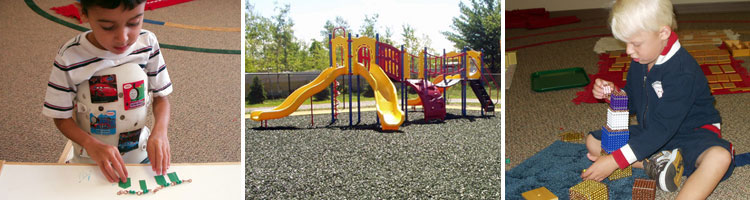
The Math Area teaches the children the concepts of number and quantity, the decimal system and fractions. Children first learn numbers and quantity separately and then have them put together. The decimal system is taught with golden beads – one bead is a unit, ten on a wire (a bar) is ten, 100 on a square and 1000 in a cube. Children use these beads to add, subtract, multiply and divide. Other materials are used as the children understand the concept of number and quantity. The children slowly move from the concrete decimal beads to more abstract materials as they grasp the various concepts that are being taught.
The Language Area teaches reading and writing. Children learn the phonetic sounds and the matching letters. As they advance, children learn to read simple three letter phonetic words. They also learn sight words and parts of speech as their reading advances. At the same time, children are also mastering their writing abilities through tracing of the letters and writing down the words that they are reading. The child’s work in the Practical Life and Sensorial Areas prepares him/her for the fine motor skills required to write.
The Cultural Area takes on many aspects of the classroom including geography, nature, science and art.
The Geography Area teaches children about the world through use of puzzle maps and globes. Children first learn that there are parts of the world that are land and parts of the world that are water. As time goes on, children learn the names of the continents and then delve into learning the names of the countries. Teachers can add to their interest in this area by providing children with books, pictures and even creating units on various countries. Children also learn about various land forms through concrete representations of the forms.
The Nature/Botany Area provides children with information about leaves, plants and animals. Children are interested in what makes up various objects. Teachers can provide children with cards and puzzles that highlight the different parts of a specific object. For example, a teacher can provide the parts of a plant. One card shows the plant, the next card is the same picture, but the stem is highlighted and named, the next card highlights the roots and so on until all the parts are shown. This can be accomplished with any object, though many children seem to enjoy animals the most.
The Science Area helps children learn about the world around them through experimentation. Children can fill a bowl with water and then test various objects to see what sinks and what floats. Children can mix colors together to find out what happens or they can experiment with making circuits and any other science activities the teacher decides to put out for them. Children can also learn about their bodies, using the “parts of cards” (explained in the Nature/Botany Area), teachers can create parts of the body, face, hand or any other aspect that interests the children.
The Art Areaprovides an area for children to express themselves. An easel is almost always present in a Montessori Classroom. Teachers could also put out watercolors or other painting supplies for the children to paint at tables. Markers, crayons, scissors, paper, collage, play dough and other traditional art supplies can be found in this area. The main rule being that there is one item, children must wait their turn to use play dough or color. Other non-traditional items could be tracing activities and tracing paper and a planned project that the children take turns creating (flowers made from pipe cleaners and cupcake holders for spring).